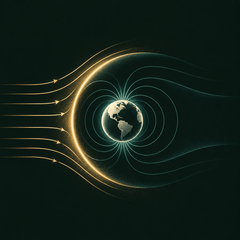
Earth has an edge. Watch the solar wind press on it.
Terra Limen reads the solar wind from NOAA’s upstream spacecraft and models where Earth’s magnetic boundary — the magnetopause — should sit right now. Every reading carries its age. A separate clock estimates when that parcel of wind reaches the boundary. Stale data is marked stale, and nothing is invented to fill a gap.
IPHONE · IPAD · NO ACCOUNT · NO AD NETWORKS · NO LOCATION
// WHAT IT IS
Measured upstream, modeled at the boundary
Terra Limen pulls the solar wind’s magnetic field (GSM Bz), speed, and density from NOAA’s Space Weather Prediction Center, then applies the Shue et al. (1998) magnetopause model to estimate the standoff distance in Earth radii. Southward Bz shows amber; northward shows muted cyan. Every color also comes with a number.
Two clocks, kept apart
Sample age is how long ago the spacecraft measured the wind. Arrival is a rough ballistic estimate of when that wind reaches the modeled boundary. Readings older than ten minutes are marked stale and their countdown is withheld.
A schematic, labeled as one
The membrane drawing uses the model’s shape. Earth is drawn larger than scale, the neighboring field lines are illustrative, and extreme values are bounded on screen. The numerical reading is never clamped.
Field stamps
Freeze a moment as a stamp: the source readings, model version, modeled distance, arrival estimate, observation time, and capture time. Add a note, then keep it, browse it, or delete it.
No invented data
If NOAA’s feed fails or goes quiet, the app says so. It never falls back to made-up numbers on its own. Sample mode uses illustrative readings, clearly marked, and runs only if you choose it.
// PRIVATE BY DESIGN
No account. No analytics. Your stamps stay on the phone.
The app requests public solar-wind files directly from NOAA. We run no server for Terra Limen and receive nothing from it. Your stamps and notes are stored only in the app and are excluded from device backups. The privacy policy has the details.
No account, no login, no telemetry, no ad networks.
No location permission. Nothing on the screen depends on where you are.
The model estimates the boundary. It does not measure it.
It does not predict whether you will see an aurora.